

Over 30 years of anarchist writing from Ireland listed under hundreds of topics
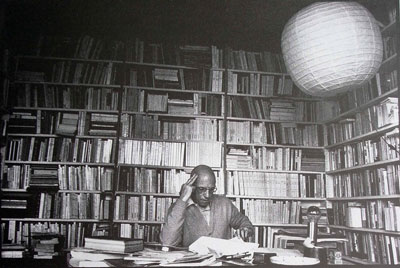 Michel Foucault is a philosopher whose politics everybody seems to have a differing opinion on. He has been called a disguised Marxist, both a secret and explicit anti-Marxist, a nihilist, a new conservative, a new liberal, a neutral interpretivist, a crypto-normativist, a principled anarchist as well as a dangerous left-wing one, and even a Gaullist technocrat. An American professor complained that an obvious KGB agent like Foucault was being invited to talk at his country’s universities and the Eastern European press of the Soviet era denounced him as being an accomplice of the dissidents.
With Al Jazerra reporting that Gaddafi has been killed during or after the closing phase of the battle of Sitre Andrew look's back at the rebellion in Libya and the decade of co-operation with imperialism that preceeded it.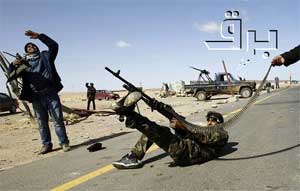
The sudden end of the Gaddafi regime some 6 months after the start of the Libyan revolt leaves some difficult questions unanswered for the left. Gaddafi’s determination to physically crush the revolt quickly transformed it into a civil war, a civil war that saw considerable imperialist intervention on the rebel side, intervention that was essential to their eventual victory. This and Gaddafi’s historic record led to some on the left taking his side in the civil war while other organisations tried to balance support for the ‘Arab spring’s’ arrival in Libya with opposition to imperialism. This question of where the balance lies between international solidarity with pro-democracy movements and opposition to imperialism could well rapidly return to the top of the agenda in a very much bigger way as the regime in Syria continues its months long military suppression of the democracy movement there.
(Image from B.R.Q. via Flickr under Creative Commons )
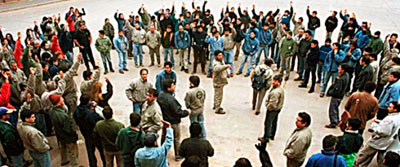 In the last issue we had a missive from the future. It told us of the great changes in the post-revolutionary anarchist world. In this article of the future society series, I will focus solely upon an anarchist vision of a future economy. This is called participatory economics, often abbreviated parecon, a classless economic system proposed primarily by activist and political theorist Michael Albert and, among others, economist Robin Hahnel. The model was developed through the 70s and 80s and the first exclusively parecon books were published in 1991. Many of their early writings concentrated on what they perceived as flaws in Marxist and Marxist-Leninist theory.
Workers Solidarity Movement position paper on Queer Liberation as re-written at the October 2011 National Conference. This position paper sits under the Sex, Gender, and Sexuality paper and does not repeat that material here.
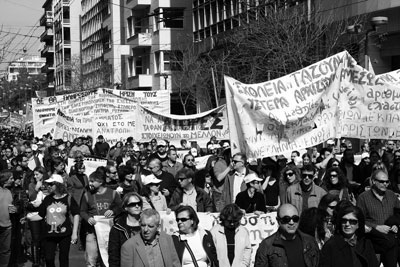 There is no doubt that the political history of Greece is full of oppression and political struggle - from dictatorships to political prosecutions, jailings, exiles, shootings, torture, civil war, and countless strikes, demonstrations, occupations and protests that are put down by extreme state violence.
 The last few years have seen a significant growth in the Freeman of the Land movement. Increasingly, its voice is being heard at environmental and other anarchist based protests and events, from the various UK climate camps to Rossport Solidarity Camp.
Anyone who has been active on the left and broader labour movement will have faced the 'million dollar question from republicans on the 'national question'. The question of opposition or indifference to the partition of the island is often thrown by republicans like a dagger in the direction of the existing left. In responnse many become either wedded to the romantic idea of the flag removing all our sins or face the jibe of being a ‘gas and water socialist’ or at worst a sop to unionism. It’s the type of choice you get at Stormont every four years where you get to choose between Coca Cola and Pepsi. Equally it’s the type of approach of the PSNI press statement that presents every ’dissenter’ from the status-quo as being wedded to physical force republicanism. But of course its much more complicated than this….
 A movement is born. Across America and around the world occupations have spread. We witness the beauty and struggle of a new protagonist joining the fight against oppression and exploitation. Crisis feeds conflict: the pillaging of communities galvanizes people from Greece and Chile, Bangladesh and China, the United States and Spain. A massive wave has been unleashed of impoverishment, unemployment, austerity, and stealing of resources by capital, governments, and the wealthy. We face loss of our jobs, homes, and way of living, with no avenue for contesting these problems within the institutions of power. Doors are being closed. Futures are being stolen.
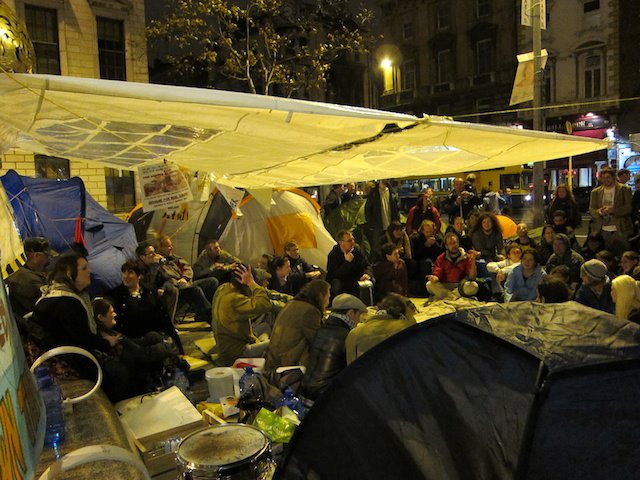 What are we to make of the global 'Occupy X' movement which has exploded onto the streets of cities across the world, turning public spaces into campsites of opposition? Certain things are obvious: Firstly, the fact that there are thousands of people across the world taking over public spaces to express their anger at the financial system is undeniably a good thing. Having camped out outside the Central Bank on Dame Street on Saturday night, I can also say that these protests exude a positivity and hopefulness that is so often lacking from the ritualistic parades of anger that make up most protest marches. But there are also, in my view, serious political problems that prevent the movement from moving beyond a 'radical sleepover' and becoming a genuine anti-austerity grassroots resistance movement.
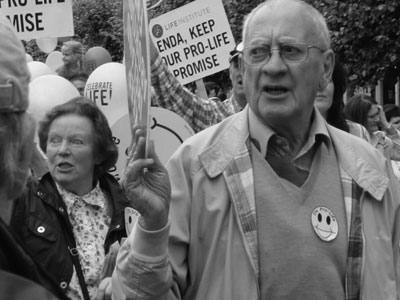 After spending tens of thousands of euro in promotion, Youth Defence’s anti-choice march finally took place in Dublin on July 2nd last. Despite the free coaches and months of preparation only about 3000 took part, making it a tiny fraction of the Pride Parade of the previous Saturday. In the week before the anti-choice march, three or four people met to initiate a pro-choice counter demonstration. This proved somewhat controversial as many pro-choice activists feel that it is better to simply ignore those who would seek to jail women to prevent them controlling their own bodes. But despite having no resources, and advertising only though a Facebook event, somewhere over 300 people turned up on Saturday to provide a counter point to the bigots parade.
