

Over 30 years of anarchist writing from Ireland listed under hundreds of topics
There’s a lot to be angry about. On the one hand mass unemployment, cut backs and pay cuts, we have death and destruction on a grand scale. On the other, the crushing boredom and alienation of everyday life. All of these various horrors are tied together, different faces of a single system. It exploits and exaggerates every tiny little difference between us from sexism to racism and nationalism, making us compete for scraps and hate each other as we fight while a tiny minority enjoy all the benefits. This system is global capitalism backed by the armed force of the state, a pattern of economic and political exploitation that reaches into every aspect of our lives. Class oppression is not simply a small cabal of the ultra-rich in Wall Street or Washington or London it's in every workplace, every police station, every dole queue, every courtroom, every prison and every territory occupied by Western militaries, and can only be sensibly understood as such.
In a statement issued after a meeting of the union’s Central Executive Committee (CEC) today (Thursday 17th November), the Irish National Teachers Organisation has said that the INTO “is not in a position to support the JobBridge initiative” and “will be directing members not to participate in the JobBridge scheme.” The issuing of this directive is a major victory for grassroots organising within the INTO. When JobBridge was first announced by the government during the summer, and when the Department of Education and Science issued a circular on how it would be applied in schools in September, the union leadership’s first reaction was to refuse to issue a directive. This despite the fact that it was clear to everyone that JobBridge was simply FAS’s Work Placement Programme (WPP) by a different name.
Armoured cars and tanks and guns did not come to take away their sons, but the peoples of Greece and Italy last week found that their elected governments had been replaced overnight by a new postmodern dictatorship of ECB-appointed "technocrat" Viceroys. Clearly in the new Eurozone, the old liberal dogma that modern capitalism and liberal democracy are joined at the hip, has turned out to be just another fairy story.
Comrades from Cairo explain why they are puzzled by the offer of Occupy Wall Street to send election monitors to Egypt for the elections when "Our struggle—which we think we share with you—is greater and grander than a neatly functioning parliamentary democracy; we demanded the fall of the regime, we demanded dignity, freedom and social justice, and we are still fighting for these goals. We do not see elections of a puppet parliament as the means to achieve them."
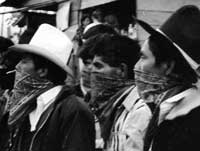 The General Assemblies of the Occupy movement are creating a global experience in Direct Democracy. But this model did not come from nowhere - among other sources of influence is the Zapatista rebellion of southern Mexico, soon to enter its 18th year. Over almost two decades hundreds of rebel communities in Chiapas have used a General Assembly model to decide on how all aspects of life in the liberated zone will be organised. Despite their different circumstances to those faced by the majoity of the Occupy camps (in urban built up locations) there is still much that can be learnt from that experience.
This piece written for the Irish Mexico Group by a WSM member a few years after the start of that rebellion looks at how the Zapatistas organise themselves in great detail, what some of the problems they had faced are and how they overcame them. It also looks further into the history of General Assemblies and Direct Democracy in Mexico and around the globe. [Note: This long text is also available as a PDF file in a number of different formats suitable for distribution]
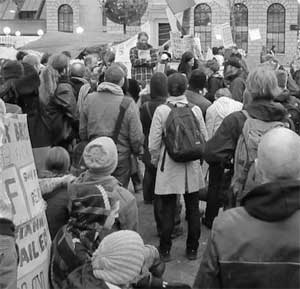 As we prepare to enter the 3rd month of the Occupy movement a commonly heard criticism targets both the lack of clear demands and the related complex and often drawn out decision making processes being used at Occupy General Assemblies. These criticisms however miss the point, against the traditional left with its package of pre-set answers (best before 1917) what makes Occupy different is that process of decision making through assembly. The assembly form is not just a way of making decisions but also a different form of doing politics. The Assembly is in embryo the different world we seek to create.
Early in the morning the crew arrive from the Occupy Cork camp to do their dish washing in the back kitchen of Solidarity Books. At 12 o'clock the days first volunteer arrives to open the bookshop and by lunch time the campers are back for the lunchtime wash up. By evening the bookshop is closed but will invariably re open by 8 for a meeting or organising group, maybe a movie showing or a talk, the Climate Campers doing their vegan cafe or it could be the Couchsurfers for their meet up, maybe the Campaign Against the HouseHold Tax for an organising meeting or just a crew to paste posters onto corriboard.
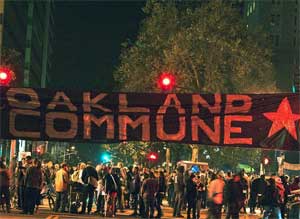 This eyewitness account of the build to and events of the 'Occupy' Oakland General Strike of Nov 2 describes how momentum developed in the aftermath of the violent eviction of Occupy Oakland, the events of November 2nd itself including the shut down of the port, the attempted occupation of the Traveler's Aid Society building and the black bloc's attack on bank buildings. The author looks at the controversy around these last two actions in the aftermath of November 2nd and warns that "If the Oakland Commune does not continue to accelerate the process of communization, it will fall back into either pure symbolism, or assume the counterrevolutionary form of reformism (two processes already in progress)"
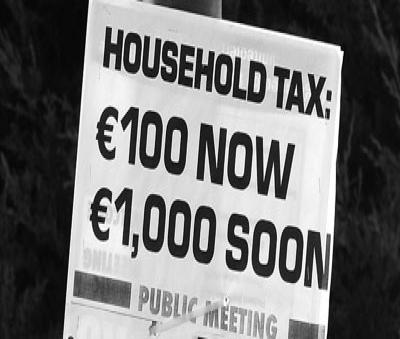 Across the country, communities have begun to organise to resist the new household tax. The government have introduced this tax, due to be levied from 1st January, at €100 per year in a bid to sneak in what will within a couple of years amount to a bill of up to €1,300 for every household, combining a property and water tax.
.jpg) The temporary release of terminal ill prisoner Brendan Lillis from Maghaberry prison, following a mass support campaign across Ireland, marked an important first step in the battle for prisoner rights. However the wider policy to punish, brutalise and isolate republican prisoners continues. Regular beatings, brutal strip-searching, denial of legal rights and recreational activities constitutes a callous disregard for the lives of political prisoners.
The temporary release of terminal ill prisoner Brendan Lillis from Maghaberry prison, following a mass support campaign across Ireland, marked an important first step in the battle for prisoner rights. However the wider policy to punish, brutalise and isolate republican prisoners continues. Regular beatings, brutal strip-searching, denial of legal rights and recreational activities constitutes a callous disregard for the lives of political prisoners.
