 |
|
|
|
|
But there is an alternative to Leninism's state capitalism and party power. It is called anarchism, a socialism which places freedom and working class management of society at the core of its vision of struggle, revolution and socialism. For anarchists, these are not optional extras which can be dispensed with as long as the right party holds state power. Not for anarchists the Bolshevik refrain of "defending the gains of the revolution" while violently repressing working class revolts for freedom and real democracy.
So what does anarchism stand for? Many take Lenin's comments in "State and Revolution" seriously when he asserted anarchists "while advocating the destruction of the state machine, have absolutely no idea of what the proletariat will put in its place" and that we would "lay down our arms" after a revolution. This is rubbish, as Bakunin argued:
"the federative alliance of all working men's associations... constitute the Commune... all provinces, communes and associations... constitute the federation of insurgent associations, communes and provinces... [to] organise a revolutionary force capable defeating reaction... [and] for the purpose of self-defence... revolution everywhere must be created by the people, and supreme control must always belong to the people organised into a free federation of agricultural and industrial associations... organised from the bottom upwards by means of revolutionary delegation."
Socialism will be free, or it will not be at all
Anarchists know what we will replace the state and capitalism with, a free federation of the directly democratic organisations created in the class struggle. These organs of class power will be the framework of a free society.
Capitalism can only be destroyed when workers expropriate their workplaces directly, using direct action to kick out the bosses. Once under workers' management, their socialisation is achieved by them federating together. The state will be destroyed by a federation of community assemblies. In both cases, decisions flow from the bottom-up by means of mandated and recallable delegates. Such a system is no impossible dream, it has existed in every popular revolution.
Our goal is freedom, equality and solidarity. All three are interdependent. Without equality, freedom is meaningless. And equality must be political as well as economic. There can be no equality between those in government and those subject to it and so equality without freedom is impossible. Anarchists, therefore, are the most logical and complete socialists, since we demand for every person not just their part of society's wealth but also their portion of social power.
Real socialism, anarchism, will be created and run from below. We reject the simplistic Marxist idea that the state is "an armed machine." This fails to address the real issue, namely that of power. Anarchists know that a revolution needs defending. The real question is who has the power. Is it the working class, in its own class organisations, or will it be a "revolutionary" government, a handful of leaders at the top using the state machine to impose its own concept on socialism onto the masses?
Anarchy in Action
Revolutionary anarchism sees class struggle as the only means of changing society. We need to organise collectively in our communities and workplaces to make real change. Only direct action and solidarity can create a power capable of not only resisting current oppression and injustice but also of changing society.
Anarchists reject electioneering. One hundred years of it produced Blair. Nor do we think marching from A to B is sufficient. If the millions who marched on February 15th had also used direct action to bring the world to a halt, then war in Iraq could have been stopped. We need to regain a sense of our own power to change things and that can only happen when we organise outside parliament and take direct action. Whether its stopping a war, getting a pay rise or saving a hospital or school, it gets results.
Anarchism is not some distant dream. We can apply it in our struggles and organisations today. Real democracy is impossible without the active and permanent participation of all the members of a group, something centralisation, by its nature, excludes. So a revolutionary organisation must reflect this, being run from the grass-roots upwards, directly democratic and co-ordinated by mandated, recallable delegates. Only self-management today can ensure freedom and equality after the revolution.
If we want to change the world, we must start by changing the way we organise and fight today.
For more information about anarchism visit:
|
|
|
|
|
|
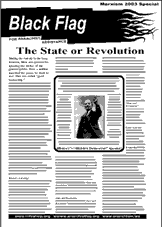
The State or Revolution
An anarchist answer to Lenin, written for Marxism 2003
The SWP versus Anarchism
Here are a few quotes from Pat Stack's Socialist Review
article "Anarchy in the UK?" which formed the basis of his
talk at Marxism 2001. Ask yourself why the SWP leadership
systematically lies about anarchism.
Lenin, History's "Hidden Democrat,"
speaks!
Stright form the horses mouth
Anarcho-Quiz on the SWP
Test your knowledge
What is Anarchism?
There is an alternative to Leninism's state capitalism and party
power. It is called anarchism, a socialism which places freedom and
working class management of society at the core of its vision of
struggle, revolution and socialism.
Another world is possible?
Under capitalism, 8 people make life and death decisions for
millions. Under Bolshevism, 19 people made them