

Over 30 years of anarchist writing from Ireland listed under hundreds of topics
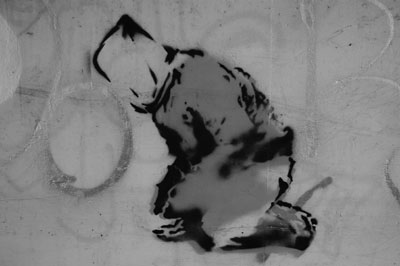 The Guantánamo Bay detention facility was created under George Bush’s Presidency in the aftermath of the attack on the World Trade Centre in New York in 2001. Described as ‘a place where normal legal rules’ do not apply, it quickly became infamous for harsh and extreme conditions of detention. Interrogators practiced a variety of torture techniques on prisoners at the facility including the now well known water-boarding procedure.
 Editors’ Note:
Much of our time as revolutionaries is spent on the routine of organising in the here and now – building a campaign, organising for a demonstration, planning for a trade union meeting…. Too often we don’t manage to take time to step back from the here and now and imagine or envisage what it’s all about. But without dreaming, without imagining a future the daily humdrum can seem dispiriting.
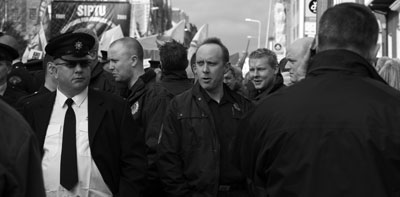 It is no exaggeration to say that the Irish trade union movement is in crisis. Even a cursory glance at trade union density figures demonstrates the depth of the crisis. Just 34% of the overall Irish workforce, and only a worryingly tiny 20% of part-time workers, are members of trade unions.[i]
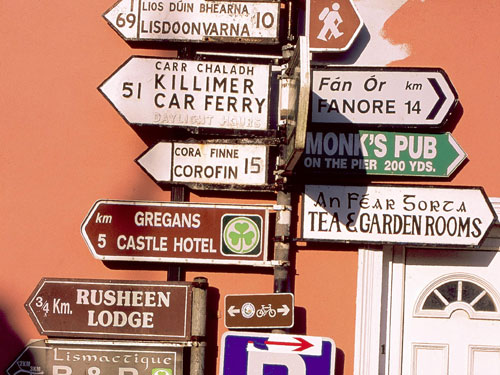 At the moment, the predominant view in the Government , the media and in business circles is that the two large, high-profile state visits by the British Queen and the US President will give a massive boost to Ireland, both in terms of increasing tourism and in terms of improving Ireland's current image of a bankrupt and disfunctional isle in the eye's of the world's media.
However, is this viewpoint accurate? It seems to me to be a naive and ill-thought out endeavour, without thinking seriously about the facts and implications.
Anarchists are those socialists who are anti-authoritarian, who place great stress on liberty and workers’ control. For this reason, we want to abolish the state at the same time as we abolish the division of society into a boss class and a working class.
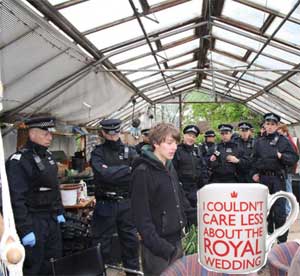 As Gardaí go door to door in central Dublin trying to intimidate any residents who might be tempted to protest against the visit of the British queen, their colleagues in Britain have mounted raids on social centers and squats across London. Five social centers were raided this morning in London and over 60 anarchists have been banned from the centre of the London on the day of the wedding of Liz's parasitic offspring. Cops used battering rams to raid 3 further houses in Hove.
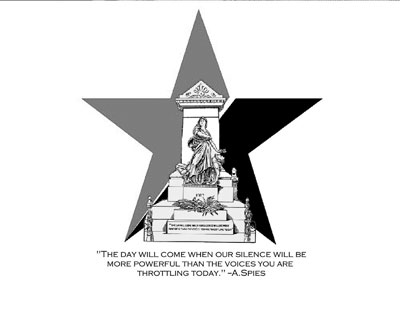 The struggle against capitalism and authority is constant but each year on May Day the labour movement takes time out to celebrate its history and achievements. Rather than dwell on the hardships of struggle we take to the streets and remember what it is we are aiming for - the emancipation of our class. Climbing a mountain means paying close attention to the ground you walk but it’s important to look up now and again in order to focus on exactly where it is you’re headed.
 A motion at the annual Congress of the Irish National Teachers Organisation (INTO) today calling for the “setting up of a policy study group” within the Irish Congress of Trade Unions to “conduct an urgent enquiry into …. the feasibility of the Irish state re-taking into public ownership” Ireland’s Natural Resources has been passed by a unanimous vote - a level of support that took even those who strongly supported the motion by surprize.
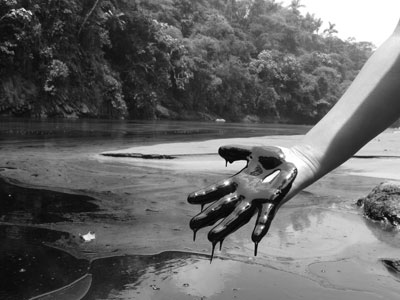 In previous issues, we examined aspects of the challenge of climate change. We have argued that carbon trading is merely an enclosure of the atmospheric commons, while carbon offsets are a form of neo-colonialism whereby the “developed north” continues to pollute while the “global south” are paid not to (please see: wsm.ie/content/high-price-lot-hot-air and wsm.ie/content/offsetting-democracy). Another, more radical, proposal is one based on prevention, that is, the non-extraction of fossil fuels. The argument is that once extracted, the use of fossil fuels is inevitable, and that any mechanisms to mitigate the increase in CO2 emissions will be unworkable.
 Kevin Rafter's “Democratic Left: The Life and Death of a Political Party” is a study of its short lifespan from 1992, when it split from the Workers Party (WP), to 1999, when it merged with the Labour Party. As such, it can be seen as a companion piece to Scott Miller and Brian Hanley’s “The Lost Revolution”, a history of the Workers Party. Rafter’s work, however, is somewhat different as it has an academic style, being his PhD thesis, which some may find off-putting. Nevertheless, it is an entertaining read for those with an interest in the dynamics of political organisations. All of the main protagonists were interviewed as part of Rafter's research and internal party documents are widely referenced, so his version of events is reasonably accurate, one would suspect.
