

Over 30 years of anarchist writing from Ireland listed under hundreds of topics
There's nothing worse than waiting for a Dublin bus at 8.10 on a rainy November morning. Well possibly one thing, getting a nice big muddy splash from a passing 98 D Volvo or Merc as it trundles by to join on to some tailback on the Rock Road or the Firhouse roundabout.
THE DUBLIN BRICKIES' strike against the big construction firm, Cramptons, showed the rest of us a thing or two about the media. Because they were victorious, the newspapers and RTE gave scant coverage to the dispute - and no report of the victory. The last thing they want is the rest of us following a good example.
MARCH 7th saw Dublin airport closed down. Clerical staff, loaders, fire fighters, mechanics, catering staff, cabin crews, computer operators, even the airport police walked off the job. When the 39 Ryanair baggage handlers who have been fighting for recognition of their union, SIPTU, were effectively locked-out; thousands of workers from all the different airport companies came out in a great display of solidarity. Taxis, buses, An Post, delivery vans refused to pass the pickets. The airport was completely shut down, for the first time ever.
We live in a world where we are encouraged to be passive. We can either accept things as they are or, at best, we can ask someone else to do things for us. That someone can be a politician, a 'community leader', or even a full-time union official. The 'experts' will look after the important stuff and we can stay at home feeling dependent and powerless. Just as there are bosses and workers, there are also leaders and led; and we are supposed to accept it as somehow natural.
When the Watergate Scandal brought down the Nixon Government in the States in the mid-70s, it was heralded as one of the finest examples of media power in modern times. Nixon's fall from grace, along with the story of corruption in high places, was the stuff of drama. In no time, the journalists at the centre of the Watergate exposé - Bernstein and Woodward - became celebrities. They went on to win Pulitzer Prizes for their journalistic endeavours and even became the subject of a Hollywood touch-up in All The President's Men.
ALTHOUGH YOU WOULD hardly know it from the media, the end of April and the start of May saw a massive strike wave in Denmark. Almost half a million workers went on strike, including almost all industrial workers and most workers in transport and building. It was so powerful that the police and other emergency services had to ask the unions whenever they needed petrol.
On February 3rd 1931, Italian police arrested Michael Schirru in a hotel room in Rome. He was Italian by birth but had become a US citizen. He had returned to Italy with one purpose, to kill Mussolini. Schirru was just one of many anarchists in the pre-war years who put their lives on the line in the fight against fascism.
The Dublin Docklands, from Ringsend to Sheriff Street, are starting a very major re-development which will take place over the next fifteen years. A Master Plan has been produced and a Dublin Docks Development Authority (DDDA) set up. Already the property developers are in the area buying up the land, a lot of which is owned by state and semi-state companies.
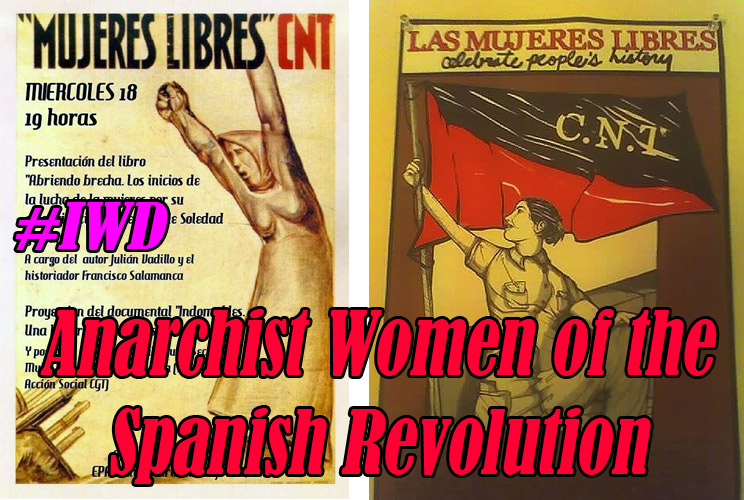 Mujeres Libres (Free Women) were a group of women anarchists who organised and fought both for women's liberation and an anarchist revolution during the Spanish Civil War. The work they did is truly inspirational. Their example shows how the struggle against women's oppression and against capitalism can be combined in one fight for freedom.
As anarchists they rejected any relegation of women to a secondary position within the libertarian movement. In the 1930's feminism had a narrower meaning than it does now, and they rejected it as a theory which fought for 'equality of women within an existing system of privileges'. They argued "We are not, and were not then feminists. We were not fighting against men. We did not want to substitute a feminist hierarchy for a masculine one. It's necessary to work, to struggle, together because if we don't we'll never have a social revolution. But we needed our own organisation to struggle for ourselves".
The Liverpool dockers were forced to end their dispute after 28 months in January of this year. But they were unbowed, the letter explaining to their supporters why they had ended the dispute ended with a quote from Jim Larkin "Who is it to speak of defeat? I tell you a cause like ours is greater than defeat can know. It is the power of powers".