

Over 30 years of anarchist writing from Ireland listed under hundreds of topics
The number of workplace related deaths in the north has increased by 50 per cent in the past year, according to latest official figures produced by the Health & Safety Executive’s annual report. To the end of March this nine people tragically lost their lives with six in agriculture, one in construction, one in general manufacturing and one due to carbon-monoxide poisoning. The increase in a casual and flexible labour force, the global erosion of workers rights and conditions are all the end product of a system which places profit before human need.
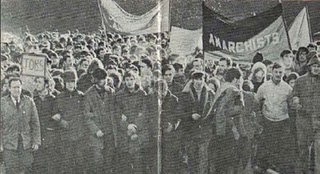
Historian Mairtin O Cathain’s ‘Wee Black Booke’ has now been added to our archive for you to read or download. In it he pulls together reports of anarchism in and around Belfast in the years from 1867 to 1973. With no local movement for much of this period, the pamphlet looks at some individuals whose political activity merited mention in the media of the time. O Cathain’s work stops before the emergence in the late 1970s of the groups from which contemporary anarchist organisations Workers Solidarity Movement and Organise! can trace their roots.
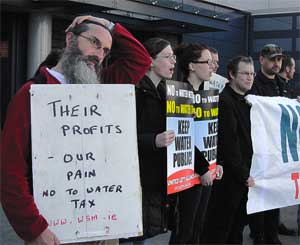 The EU and IMF, enabled and supported by our Fine Gael/Labour Government, are imposing a new regressive tax on all of our homes. This tax will take no account of the ability to pay and will almost certainly move in only one direction (upwards) over the years once it is introduced.
Newspapers
The Anarchist (Glasgow)
Belfast News Letter
Belfast Telegraph
Freedom
Irish News
Anyone looking for a rogue’s gallery or general litany of scallywags in this short history of Belfast anarchists will be disappointed. It is a story of small movements and peripheral figures gathered together over many years and presented to you, the reader, as an account of how Belfast produced and received anarchist activists. It is uneven in places, sketchy on context, and optimistic in analysis.
If Captain Jack White DSO, CNT, was the first of the great individual characters of northern anarchism, those that followed soon after into the later twentieth century were every bit as unique. ‘Slumdom’ Jack McMullen and John McGuffin were not merely products of their time and social circumstances, but transcended the context into which they were born and the politics of their generation. They were in every sense truly dynamic libertarians whose politics speak to us of a far greater and more diverse political culture in Belfast than we have hitherto been led to believe. They also have in common a type of writing whose style approximates to a combination of Emile Zola and Spike Milligan. This makes both individuals fascinating to read though at times perplexing, and it is their writing which marks them out as much as their activism.
It was not until the early twentieth century that an anarchist group was established in Belfast. Although we have little information on anarchists elsewhere on the island, it seems entirely possible that this was the first specifically anarchist group north or south. It emerged in a time of rising militancy, though not working class militancy, and when communal relations were especially strained, and proceeded from the propagandist labours of two remarkable Scottish anarchists. One of these individuals, John or ‘wee’ McAra, as he was also known, is a subject in this chapter.
Ireland, more than most countries in nineteenth century Europe, had a sizeable rate of emigration, between 1801 and 1921, for example, it is estimated that the population declined by 8 million.(1) As it had a bearing on almost every aspect of life it necessarily also affected political movements on the island, and contributed significantly to political movements elsewhere in the world where Irish emigrants settled.
It was a great pioneer of labourism in the north, Hugh Gemmell, who once exhorted fellow workers here to have two chief loyalties - loyalty to yourself and loyalty to your class. Gemmell was about as far as any old Northern Ireland Labour Party man could be from anarchism, but his note on loyalty is a not inauspicious place to begin a discussion on anarchism in Belfast.
Had the tabloids been taken at face value, many would have us believe that ‘anarchy’ reigned in Belfast on a regular basis over the past thirty to forty years. Unfortunately, that was not the case. However, the equation of anarchy with violence is nothing new and the word continues to be misapplied in almost every context from the chimpanzee house at Belfast Zoo to the streets of Iraq. Partly this is ignorance, partly laziness, and partly deliberate and malicious misapplication by politicians and the media.