

Over 30 years of anarchist writing from Ireland listed under hundreds of topics
The housing crisis for home buyers and private renters is in part due to the arrival of thousands of people into the country. The vast bulk of these people were born in Ireland but became 'economic' refugees and left for other countries to find work over the last few decades. The lucky ones did so legally but many thousands however were forced to enter the US as 'illegals'.
After six years of massive house price increases it is now almost impossible for the average worker to buy a house in Ireland. Average house prices in Ireland rose from 11.3 times the average income in 1989 to 18.2 times income in 1999. The increases in rent and house prices have, for many workers, completely wiped out any gain made from tax cuts in our take home pay. And for the poorest and most vulnerable sections of the working class the housing crisis is becoming a disaster as the rapidly growing number of young people sleeping on the streets demonstrates.
If you've ever owed money to a bank, you'll know it's not a pleasant experience. Depending on whether they think you're good for the money, the bank will either screw you in the short term or milk you dry over the longer haul. Banks are in the business of making money and generally they'll stop at nothing to get their way.
The Czech anarchist organisation Solidarita/Organisation of Revolutionary Anarchists is working as part of INPEG, the Czech alliance organising the protests in Prague this September. In October one of their members will be speaking in Ireland about these protests. Vadim Barek, Solidarita's international secretary explains what the IMF means to workers in the Czech republic and why they are organising against the summit.
The strike at the Aldi supermarket on Dublin's Parnell Street came to an end on Friday August 18th. It marked the end of a bitter three month struggle for union recognition. There had been mass pickets, sympathy protests at Aldi shops in Letterkenny, Galway and Cork, and generous donations from members of MANDATE and other unions.
They are the sort of deaths which rarely merit more than a passing reference in the mainstream media - a battered ship which sinks in the Mediterranean, a stowaway found dead in the cargo hold of a ship or plane, a nameless asylum seeker who takes his/her life, no longer able to take the pressure in one of the EU's many 'detention centres'. Now and again, as with the 58 Chinese people found dead in the back of a truck in Dover in June of this year, the cases are so horrific that they cannot be ignored. Then they become big news for a day or two only to sink off the political agenda just as quickly.
In December 1996, following a two-and-a-half year long campaign of people power, the then government was forced to abolish water and sewerage charges throughout the State. The principal argument against these charges had been that they were a form of double taxation on ordinary workers, already shouldering an unfair proportion of the tax bill through PAYE income tax and indirect taxation.
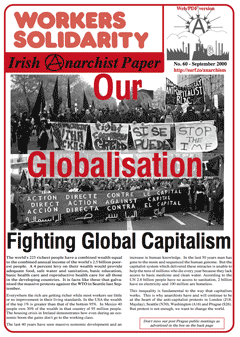 The world's 225 richest people have a combined wealth equal to the combined annual income of the world's 2.5 billion poorest people.
THE NORTHERN EXECUTIVE (the wanna-be government of the six counties) is gone for the moment. The leaders of the UUP, SDLP and Sinn Féin had been getting used to the Ministerial high life. They were not eager to let it go.
AT THE MOMENT there are approximately 236,400 people working in the wholesale and retail trade. Most of us working in this sector are badly paid, as unskilled labour usually is. Recently Roches Stores office workers went out on strike for better pay. Some of them were being paid as little as £4.16 an hour. They were successful and got a 25% pay rise.
