

Over 30 years of anarchist writing from Ireland listed under hundreds of topics
The NO victory in Ireland is a clear demonstration of the lack of support among the people for the European project being promoted by the Brussels technocrats and the transnational corporations grouped together in the capitalist cartel, the European Round Table of Industrialists (ERT). This rejection by the country with the highest levels of approval and popularity for the EU shows that a different form of European unity is needed, a real unity of all the people. And the gap between public opinion and their "representatives" is a clear sign of the crisis in representative democracy and the need for direct democracy.
A number of weeks ago, a member of the INTO (Irish National Teachers Organisation) submitted a letter for publication in the union magazine ‘In Touch’. This was in response to a request in the previous issue of the magazine for members to write letters for publication.
March 15th saw Dublin’s third annual Anarchist Bookfair. Despite a day-long downpour, over 800 people passed through. Thirteen different meetings were held on topics as varied as the health service, the Lisbon treaty, climate change, feminism and class, and trade union organisation. Interest in finding out more was reflected in the €3,000+ worth of books and pamphlets purchased from stalls operated by Workers Solidarity Movement, CAZ Books, Just Books, Anarchist Federation of Britain, Irish Socialist Network, Oxfam Bookstore and others.
So building social housing is "not viable" for the profiteers at construction firm Michael McNamara & Co. What they really mean is that they've got themselves in a bit of a sticky situation by riddling the country with overpriced and unsustainable housing developments and the profits from the "Public Private Partnership" aren't sufficient to get them out of it.
Britain, France, Germany, the US, and a host of other countries the last 25 years have seen very large movements seeking to close down nuclear power stations. Ireland hasn't. We didn't need to. A big victory was won here when we stopped the then Fianna Fail government going ahead with their plans to build not one, but four, nuclear power stations at Carnsore Point in Co. Wexford in the late 1970s.
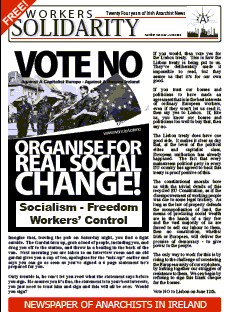
Issue 103 of Workers Solidarity -May-June 2008
Articles in this issue include:
This is an extraordinarily detailed exposition of how the modern media functions. The author, veteran Guardian journalist Nick Davies, along with a team of researchers from Cardiff University, spent several years monitoring the British media and tracing the sources of the stories that they carried. The results were pretty shocking, even for somebody who already has a very low opinion of the corporate and state media.
Imagine that, leaving the pub on Saturday night, you find a fight outside. The Gardai turn up, grab a load of people, including you, and drag you off to the station, and throw in a beating in the back of the van. Next morning you are taken to an interview room and an old garda gives you a cup of tea, apologises for the “mix-up” earlier and says you can go as soon as you’ve signed a 6 page statement he’s prepared for you.
The Paddington Rail crash in London in 1999 led to 31 deaths and well over 400 injuries. At fault was a simple set of rail signal lights which were difficult to see (from the train driver’s point of view). When the crash was investigated it quickly emerged that Network Rail (then called Railtrack), the company responsible for rail line maintenance, had been repeatedly warned about the danger. A number of drivers had been involved in near misses and reported this to management, yet nothing was done. Then two high-speed trains collided.
