

Over 30 years of anarchist writing from Ireland listed under hundreds of topics
.jpg) This May sees the return of the annual Anarchist Bookfair to Dublin, the seventh to be held to date. Since the first, back in 2006, the event has grown hugely in scale, against the background of the bursting of the Celtic Tiger bubble, the IMF/EU bailout and the catastrophic effect of austerity on Irish society. The Bookfair consists of a day of meetings, debates and discussions and will also host bookstalls and information stands from a large number of political organisations and campaigning groups.
This May sees the return of the annual Anarchist Bookfair to Dublin, the seventh to be held to date. Since the first, back in 2006, the event has grown hugely in scale, against the background of the bursting of the Celtic Tiger bubble, the IMF/EU bailout and the catastrophic effect of austerity on Irish society. The Bookfair consists of a day of meetings, debates and discussions and will also host bookstalls and information stands from a large number of political organisations and campaigning groups.
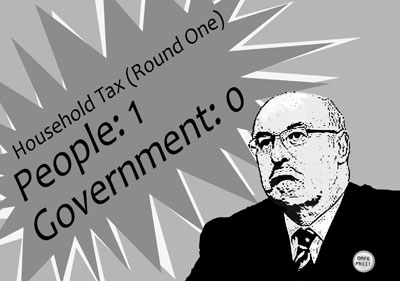 The Campaign Against Household and Water Charges (CAHWT) has been hugely successful so far in several ways: in encouraging mass non-payment; in making the taxes a big political issue, even in the mainstream media; in getting tens of thousands of people involved in protests and public meetings.
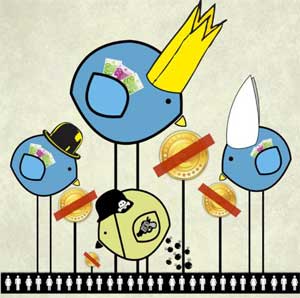 The government parties are billing it as the ‘Stability Treaty’, the left opposition – most notably the United Left Alliance – are calling it the ‘Austerity Treaty’. For the next few weeks we can expect the airwaves to be clogged with the pros and cons in the lead-up to the 31stMay referendum on the “Treaty on Stability, Coordination and Governance in the Economic and Monetary Union” to give it its official title.
But despite all that we will hear between now and the end of the month, does anyone seriously think that how we vote will make one whit of difference?
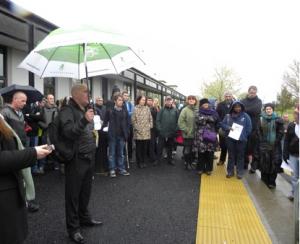 Upwards of 50 staff and students attended a protest at NUI Maynooth today in a show of solidarity for fellow student Jerrie Ann Sullivan in the wake of the report into the Rossport “rape tape” incident released this week by the Garda Síochána Ombudsman Commission. The impromptu protest, organised by the NUIM Politics and Sociology Society, was called to register the “abhorrence” of the rape comments incident and its handling by GSOC and Irish media. Despite the wet and windy conditions, the crowd listened to a range of speakers each of whom condemned GSOC’s handling of this particular case and policing in Corrib more generally.
With the announcement today by the TEEU and Unite that they are urging a No vote in the forthcoming Fiscal Compact Referendum allied to the fact that Mandate announced a similar position yesterday a clear division is emerging between the leading trade unions. SIPTU has basically offer its support for the treaty in return for a funded job creation plan, this is basically the union leadership buying time before it falls in line with Labour and calls for a yes vote.
The Irish Times/ IPSOS like all polls is only a snap shot in time they say, but polls can be helpful indicators of the public mood when they contain useful questions. This particular poll covered a number of areas the usual poll of party support, leader popularity and government satisfaction, opinion on the fiscal compact referendum and most interestingly opinions on the household and water taxes as well as a question about cutting social welfare.
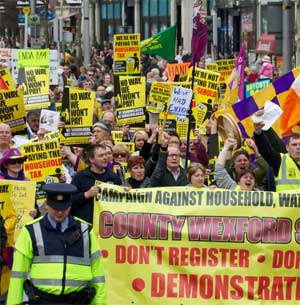 Dan Hayden and Colin Scott (‘Why People Avoided Paying Household Charge’ 16th April) should get out of their academic ivory tower and talk to some real people if they want to answer the question as to why almost a million households have decided to put themselves in conflict with the government by refusing to register for and pay the household tax. Instead of presenting any real analysis of what is by any stretch of the imagination a massive rejection of government policy they start off by insulting those who decided not to register and go on to present a hotch-potch of half-baked theories which seem designed to do anything other than admit the truth – people made a conscious political decision not to pay.
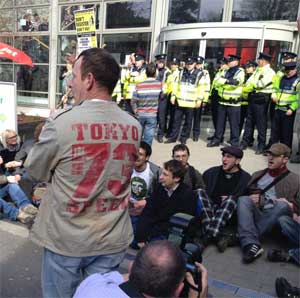 Thousands of people marched from Eyre Square in Galway to the Labour Party conference at NUIG on Saturday. People had travelled from all over the country to show their opposition to the household tax and other attacks on people’s living standards. The story that made the evening news however, was one of the several hundred strong breakaway protest that reached the doors of the conference centre.
Two recent surveys have shed a little light on the levels of poverty and financial distress being experienced in Ireland. A survey by the "What's left" found 47% of households (over 1.5million people) with €100 or less in hand monthly after essential bills have paid. The other survey by Social Justice Ireland calculated over 700,000 people now live impoverished lives in the state. The increasing cost of essentials, declining wages and rising unemployment are all contributing to this.
This technical note was produced by Shell to Sea to counter the misleading implications about file deletions found in the GSOC July 2011 ‘Interim Report’ into the Corrib cops 'rape tape' incident. It was published as part of a Shell to Sea response into that report. GSOC had used language to suggest that the recordings of the incident itself had been interfered with, a suggestion that was picked up and incorrectly reported by many sections of the media as fact. RTE were later forced to issue an apology for their inaccurate reporting.
