

Over 30 years of anarchist writing from Ireland listed under hundreds of topics
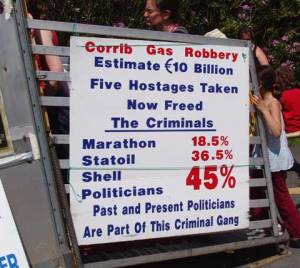 Throughout the world, public services have been under attack for the past twenty years. Forming a central plank of the capitalist globalisation agenda, ‘privatisation’ and ‘competition’ are the seemingly unchallenged dogma of modern capitalism. The levels of privatisation which have taken place worldwide are absolutely mindblowing. During the 1990s alone over $900 billion worth of public assets were transferred into private hands. Globally this agenda is pushed by the World Bank and the World Trade Organisation (WTO). The basic theory by which these bodies operate is that all decisions should be made on the basis of profitability alone.
The Workers Solidarity Movement administration document on Relations with other left groups in Ireland.
Made in 1990s, last amended at WSM National Conference, July 2017.
Workers Solidarity position paper No Platform for Fascists as ratified at April 2006 National Conference. This sits under the Fascism position paper, refer to that for more context.
Workers Solidarity Movement position paper on Travellers Rights as rewritten Oct 2008 National Conference
The Workers Solidarity Movement postion paper on Fighting Racism as ratified at November 2010 National Conference. Note this paper is dated and where conflict exists the Anarchism, Oppression & Exploitation is a better reflection of our positions.
WSM position paper on the partition of Ireland. Last debated and updated at the April 2009 conference. It sits under the State and Democracy position paper.
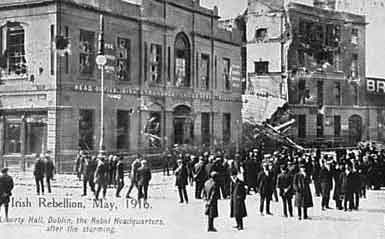 At 11.30 in the morning of April 24 1916 Bugler William Oman, a member of a syndicalist workers militia the Irish Citizen Army (ICA), sounded the 'fall-in' outside his union headquarters. This was the start of an insurrection in Dublin which was to see around 1,500 armed men and women seize key buildings throughout the city, and to hold these positions against thousands of British Army soldiers for almost a week. In the course of putting down the insurrection, 1351 people were killed or severely wounded and 179 buildings in the city centre were destroyed.(1)
Image: Liberty hall after the rising
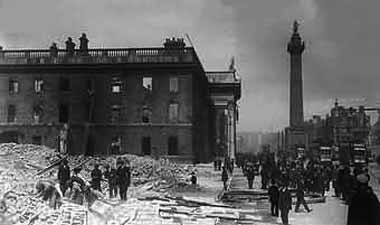 This article is an anarchist analysis of the 1916 insurrection and the war of independence in the context of the struggle for socialism in Ireland and internationally. It concentrates on the 'unknown' but intense class struggle that ran alongside the war of independence and the role republicanism played in the suppression of that struggle. It asks 'what is freedom' and shows how anarchism originated amongst earlier European left republicans as an answer to the limitations of republicanism.
Image: O'Connell street after the insurrection
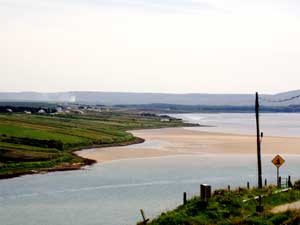 The economic boom in Ireland and the construction boom that has come alongside it has led to a growth in the importance of environmental campaigns. There has frequently been a large gap between the environmentalists involved in such campaigns and the left - including anarchists. Sean, one of the 'Carrickminders' and now a member of the WSM gives his view on what can be learnt from the recent struggles. Capitalism in Ireland is certainly booming. The country in profit based terms has seen unprecedented growth. This growth is illustrated on the great barometer of Capitalism- GDP (Gross domestic product) which has increased each year since 1991.

Compared to many other European countries May Day demonstrations have always been small in Ireland, even in the 1980's when the Stalinist left was much more influential and the unions were much more powerful. By the mid-1990's, with the old left in complete disarray and the union bureaucrats more focussed on partnership with the state and the bosses rather than workers' rights, May Day had become a fairly underwhelming event.
So, given this dismal tradition why were the explicitly libertarian May Day events in 2004, comparatively speaking, such a success? Of course there was the impetus of a major European Union summit but to understand why anarchists were in a position to organise big May Day events calls for a brief examination of the development of libertarian ideas and practices in Ireland over the past few years.
