

Over 30 years of anarchist writing from Ireland listed under hundreds of topics
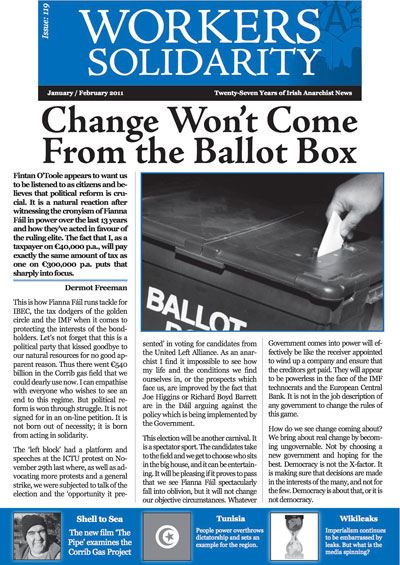 January - February 2011 Edition of the Workers Solidarity freesheet.
PDF of Workers Solidarity 119 Web Edition 2.4 Mb
Government Attacks on Healthcare
Change Won't Come From the Ballot Box
Thinking About Anarchism: Can Ireland Go It Alone?
People Power in Tunisia
The Budget & The Rich
Review: The Pipe
Wikileaks: Terrorists or Freedom Fighters?
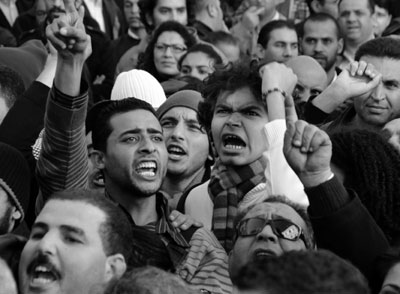 On Saturday December 18th last, the Tunisian police stopped Mohamed Bouaziz, an unemployed university graduate, and seized the hand cart of fruit and vegetables he had been selling to support himself and his family. Enraged by the injustice and despairing of any escape from destitution and starvation in Tunisia’s impoverished economy, increasingly ravaged by rising food prices, the young man set fire to himself in protest outside the town hall in Sidi Bouzid, 200km south-west of the capital Tunis. The young man was later to die in hospital.
 Wikileaks continues to make almost daily headlines. Aside from the various revelations, there are also two widely told stories that are supposed to help us put these leaks into context.
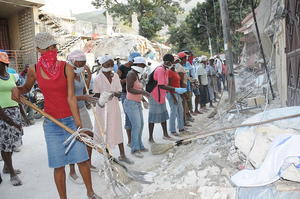 One year after the devastating earthquake that struck Haiti, the conditions endured by the ordinary people there are as bad, or worse, than they were before the earthquake. Of the billions of dollars promised by governments around the world to rebuild the devastated country only a fraction has reached the people of Haiti.
On 5 January, the frustration, deep unease, and hopelessness of young Algerians exploded onto the streets. Since then, they have been throwing stones, burning tires and brandishing any object that they can turn into a weapon. By Amel Yacef
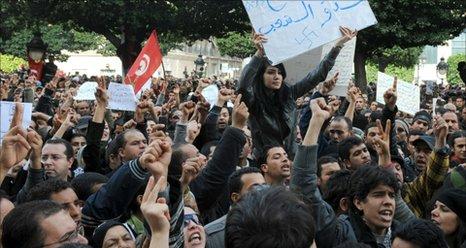 After a dramatic 24 hours when Tunisia's dictator president Ben Ali first tried promising liberalisation and an end to police shootings of demonstrators and then, this evening at 16:00, declaring martial law, he has finally fallen from office. While the rumours are still swirling, one thing is clear, Ben Ali has left Tunisia and the army has stepped in.
A mass wave of riots by ordinary people against the government have swept Tunisia for the last three weeks under a near-total media blackout in the West. We look at what's been happening and why it's being kept off our TV screens.
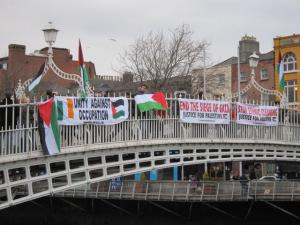 New Years Eve in Dublin saw a gathering on the Hapenny bridge in Dublin to mark the anniversary of 'Operation Lead' when the Israeli attack on Gaza killed more that 1400 people. Meanwhile in Israel there were arrests of Israeli activists protesting the killing of a Palestinian women, Jawaher Abu Rahmah by teargas.
Donal Fallon profiles some of the women who played a large part in the illustrious history of the Industrial Workers of the World.
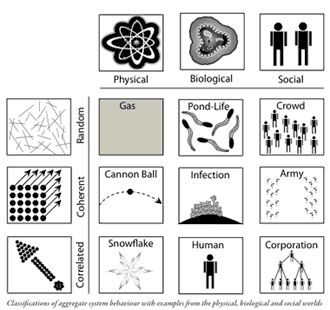 Analysing human societies as complex systems can provide an insight into historical processes and the strengths and weaknesses of capitalism.
Complex systems theory is a scientific theory coming out of a tradition of catastrophe theory, chaos theory, control theory, and especially cybernetics. Complex systems theory arises as a rejection of the traditional programme of reductionist science. It rejects reductionism as being both unnecessary and intractable.
Traditional physics has attempted to find fundamental laws at the smallest granularity possible. However, it is now known that because of the nature of interactions at very detailed granularity, it can be computationally intractable to predict behaviour of aggregate systems. Water, for instance, is best described (under most conditions) with fluid flow equations which describe aggregate behaviour with relatively simple (non-linear) equations. Attempting to describe it as an aggregate wave function of 1026 interacting quantum particles is not computationally feasible. Instead complex systems theory attempts to describe systems at a natural granularity that allows for tractable prediction of behaviour.
