

Over 30 years of anarchist writing from Ireland listed under hundreds of topics
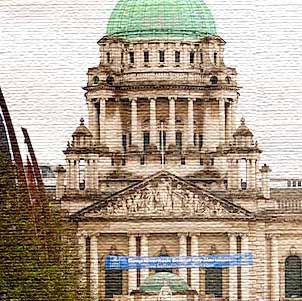 The eruption of conflict and intense rioting in Belfast over the last couple of months is a clear illustration that, no matter what lengths Stormont and the media circus go to to disguise the ugly reality of the ‘peace process’, the scars of the past and frequent eruption of sectarian conflict refuse to go away as political parties play the sectarian card to get one over on their rivals.
With over 300 police officers apparently injured so far this year, the honeymoon period following a 'successful' G8 conference has long passed - lifting the veil from a colonial sectarian settlement that has delivered a few crumbs to our class while the rich get richer. While at the same time our rulers in Stormont are busy stuffing themselves with £250,000 subsidised food expenses in 2012.
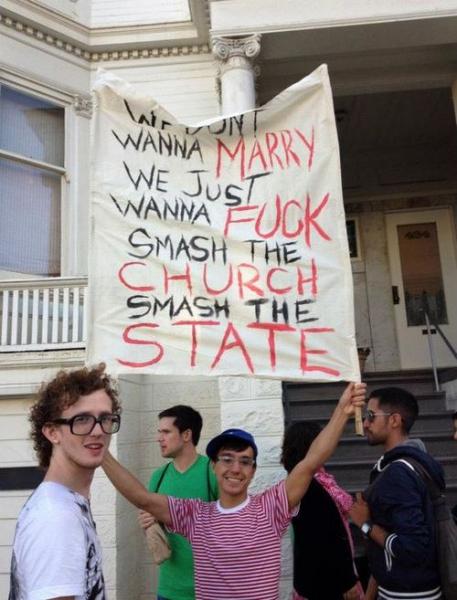 “Conservatives believe in the ties that bind us. Society is stronger when we make vows to each other and we support each other. I don’t support gay marriage in spite of being a conservative. I support gay marriage because I am a conservative.” ― David Cameron
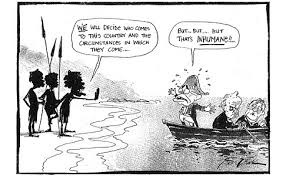 An Irish anarchist living in Melbourne, Australia gives his perspective on the 'asylum seeker' debate there leading up to the forthcoming elections. He argues Irish workers should be standing in solidarity with the most marginalised and dispossesed in our society. In the words of one Aboriginal activist; ' “As people who know what it’s like to be invaded by boat people we are in a better position to judge how the current boat people should be treated. Where the original boat people who took our country were armed to the teeth and bent on conquest, asylum seekers in 2012 are unarmed and seeking sanctuary."
 The chief advantage that would result from the establishment of Socialism is, undoubtedly, the fact that Socialism would relieve us from that sordid necessity of living for others which, in the present condition of things, presses so hardly upon almost everybody. In fact, scarcely anyone at all escapes.
 A younger comrade explained to me how he had travelled over 600 miles to be allowed into a field in Fermanagh to destroy a fence which had been specifically erected for that purpose. It was a sacrificial offering to the black block, complete with blunted razor wire so that they would not injure themselves in the thrashing. Just when you thought this scene could not get any more surreal, hear this. Beyond this field lay another barrier, and inside that fence there was a man from the security forces stating that if anyone attempted to get into this field there would be serious consequences. As per normal in these situations, the violence was always going to come from those in uniform. The stewards from the Socialist Party approached the black block and explained to them that the busses were leaving.
On a private island in the lake, far away from this absurd scene, the leaders of the G8 were meeting undisturbed.
Andrew, a member of Workers Solidarity Movement, gave an eyewitness account with photos of the Gezi park protests and the state brutality against people in Istanbul, where he spent a week recently. Sevinc , an anarchist from Turkey, gave details of the background of the struggle.
The video is includes photos & video from Gezi park. Recoded Thursday 27 June, 7.30 at Wynns hotel, Dublin
The Prisoners’ Rights Organisation (PRO) was founded in the early 1970s. Before its dissolution in the late eighties it was in many ways a unique phenomenon - a small but highly energetic grassroots organisation that consistently called public attention to cases of police brutality and misconduct through varied forms of street protest and media work. This article tells the story of the formation and development of the organisation and the ‘hidden history’ of the PRO’s attempt to make police accountable.
How have activists tried to put manners on the police? Which methods have worked? Which might be worth trying? This article is a brief overview of different ways of resisting political and social policing.
This essay attempts to describe some of the highlights of the policing of political protest in the Republic of Ireland from the late 1960s to the present day. We may begin with some obvious generalisations: there are differences between Garda policing of protests by ‘respectable’ and ‘non-respectable groups’, and protests by republicans or radicals receive more forceful policing than protests by trade unions or farmers. The difference lies in garda perception of the legitimacy of these protesters, not in the groups’ actual protest behaviour. Farmers were permitted to use disruptive tactics while peaceful marches were physically attacked. Throughout the period in question we can see Garda response to protester innovations, although responses were not limited to the gardaí. We should note the state legislative response to protest through the passage of laws such as the Forcible Entry Act and successive Criminal Justice Acts broadened Garda powers to intervene in and control protest.
