

Over 30 years of anarchist writing from Ireland listed under hundreds of topics
The second Dublin anarchist bookfair saw a debate between the Workers Solidarity Movement, Eirigi and the Irish Socialist Network on the topic of 'What sort of Ireland do we want?'. These are the speakers notes from the WSM speaker for that discussion
Audio from the 2nd Dublin anarchist bookfair of Emmet O'Connors talk on Syndicalism in Ireland and the discussion that followed it.
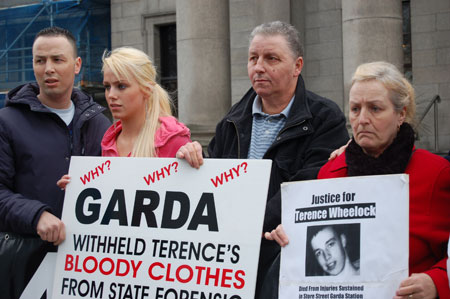
To people living in the North Inner City, the recent revelations at the Dublin City coroner’s court at the inquest into the death of young Terence Wheelock will not come as a surprise. Terence went into a coma from which he never recovered, after sustaining injuries in Store Street Garda station. One witness to his arrest said the Gardai ‘whacked Terence’s head off the side of the van and twisted his broken arm behind his back’.
At the second Anarchist bookfair, Saturday 3rd March 2007, speakers from Workers Solidarity Movement, Irish Socialist Network and Eirigi discussed the question 'What Sort of Ireland Do We Want?'. These are the audio files of this debate.
Dublin anarşist kitapfuarından ses dosyaları --- 3 Mart Cumartesi günü, ikinci Anarşist kitapfuarında, İşçilerin Dayanışma Hareketi, İrlanda Sosyalist Ağı ve Eirigi'den konuşmacılar, 'Nasıl bir İrlanda İstiyoruz?' sorusunu tartıştılar. Bu tartışmanın ses dosyaları bulunuyor.
In times past Dominick Street - developed in the 1750s by the Dominick family - was the “first settlement” of fashionable Dublin and much favoured by “the quality”. It housed such notables as William Hamilton; the mathematician who was elected the first foreign member of the National Academy of Sciences of the USA was born in No.36, horror writer Joseph Sheridan Le Fanu in No.45, and Sinn Fein founder Arthur Griffith in No.4.
In 1984, 11 workers in Dunnes Stores, Henry Street, went on strike as they refused to handle goods produced by the racist South African Apartheid Regime. The ten women and ond man stayed out for over 2 and a half years, and their courage inspired many people around the world.
The piece is the crucial fifth chapter of the Inquiry. This is the turning point of the book where Thompson accepts that his original project of creating a liberatory economics on the basis of classical liberalism, albeit taken far further than any previous exponent had dared, had been overtaken by an acceptance of the limits of even the most perfected system of "free" exchange. This chapter starts with an admission that he has dumped the previous written version for this new departure. In passing he gives the section headings for the original text, covering the demands necessary for the achievement of his original goal of "free exchange". The crucial section of this chapter is his dissection of the faults of even the most perfected system of exchange. His seminal framework of 5 points is still capable of enriching contemporary critique of exchange, despite the datedness of some of the problems which have to some extent been mitigated in the intervening 180 or so years by the gains of workers' and women's struggles and the subsequent development of consumer capitalism and the welfare state.
John Monaghan is a resident of Rossport county Mayo and part of the Shell To Sea campaign. Shell's pipeline, if it were built, would be located less than 70km from his home. Here he speaks about how the jailing of his father in law Micheál Ó Seighin drew him into the campaign and how the struggle against Shell has raised greater national questions for him about local democracy and control of natural resources.
Końcem 2005 roku dwa promy należące do Irish Ferries zostały okupowane przez załogę broniąca się w ten sposób przez wkroczeniem ochrony która miała za zadanie zastąpić ich pracowników innymi. W piątek w rożnych miastach Irlandii ponad 100 tysięcy osób opuściło swe stanowiska pracy przystępując do marszu solidarnościowego z uczestnikami okupacji. Ugoda z firma została osiągnięta ,związki obwieściły zwycięstwo ale czy ta ugoda to prawdziwe zwycięstwo?
