

Over 30 years of anarchist writing from Ireland listed under hundreds of topics
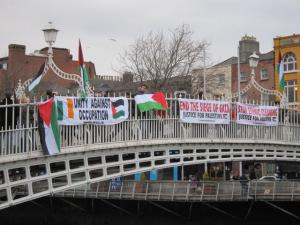 New Years Eve in Dublin saw a gathering on the Hapenny bridge in Dublin to mark the anniversary of 'Operation Lead' when the Israeli attack on Gaza killed more that 1400 people. Meanwhile in Israel there were arrests of Israeli activists protesting the killing of a Palestinian women, Jawaher Abu Rahmah by teargas.
Donal Fallon profiles some of the women who played a large part in the illustrious history of the Industrial Workers of the World.
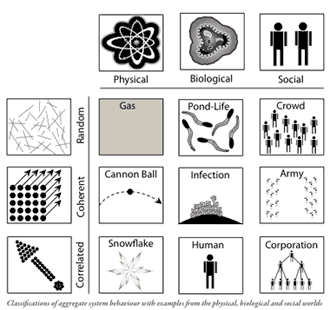 Analysing human societies as complex systems can provide an insight into historical processes and the strengths and weaknesses of capitalism.
Complex systems theory is a scientific theory coming out of a tradition of catastrophe theory, chaos theory, control theory, and especially cybernetics. Complex systems theory arises as a rejection of the traditional programme of reductionist science. It rejects reductionism as being both unnecessary and intractable.
Traditional physics has attempted to find fundamental laws at the smallest granularity possible. However, it is now known that because of the nature of interactions at very detailed granularity, it can be computationally intractable to predict behaviour of aggregate systems. Water, for instance, is best described (under most conditions) with fluid flow equations which describe aggregate behaviour with relatively simple (non-linear) equations. Attempting to describe it as an aggregate wave function of 1026 interacting quantum particles is not computationally feasible. Instead complex systems theory attempts to describe systems at a natural granularity that allows for tractable prediction of behaviour.
This article from Red & Black Revolution 15 describes and explains the internal organizational structure of the WSM as it was in 2008. See the WSM Constitution to get an idea of any changes that may have been made since. This article was originally a box in the article Practical Anarchist Organising.
Over the last few years, the Workers Solidarity Movement, the anarchist organisation that publishes this magazine, has grown considerably. We went from being an organisation with only a dozen members or so, to an organisation six times that size. As part of that growth we have had to reassess our internal workings and devise a range of new processes and structures for communicating, coordinating and democratic decision making. This article describes this process of change. It is hoped that it may serve as a useful case-study for other groups facing similar problems and as a small demonstration of the how anarchist organisational principles can be applied in practice.
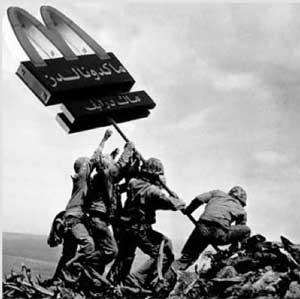 This articles charts the course of global geo-politics since the end of the Cold War, the emergence of new regional powers and the recurring cycle of crises in neoliberal capitalism that culminated in the great financial crisis of 2008.
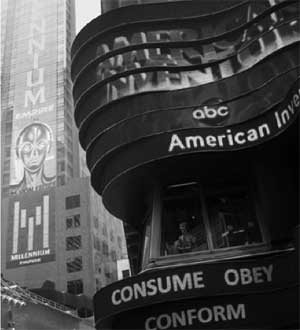 This article tells the story of the historical development of the regime of global financial order under US hegemony. It begins by examining how the centre of capital accumulation shifted from Europe to the US in the first half of the twentieth century, and how following World War II the global financial order became centred around the US through the Bretton Woods system. It then looks at how the Bretton Woods System was undermined, concentrating as much on the role of workers militancy as on the role of the Eurodollars market. After considering the response to the crisis of Bretton Woods, it concludes by looking at the Clinton boom, bringing us up to the current situation of the US’s current heavy dependence on foreign borrowing
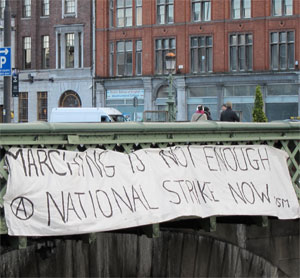 In this detailed interview for the North American Ideas & Action site Kevin Doyle of the Cork Branch of the Workers Solidarity Movement answers questions about the current Irish financial melt-down and the popular resistance. [Spanish translation]
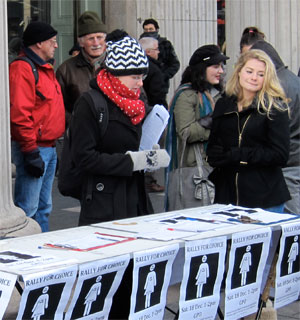 Saturday 18th December saw activists from a number of pro-choice organizations including the WSM rally at the GPO in Dublin to mark the European Court of Human Rights ruling in the ABC case. The short rally which took place in the bitter cold had been called at just over 24 hours notice by the Feminist Open Forum but still attracted a few dozen activists who have been involved in campaigning against Ireland's ban on abortion in the last decades.
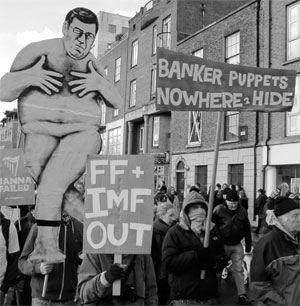 On Tuesday the 7th of December, the Irish government were barricaded inside the parliament in Dublin. They were there to vote on a Budget implementing the cutbacks and austerity measures demanded of them by the IMF and ECB. The budget comes in a year of ever deepening crisis, as the debt of what was once Europe's fastest growing economy, spiralled out of control. The obvious question one is faced with is “What went wrong? What happened to this economic miracle?